Home > Blog > Fishing multiple rods at once
· Marcus Hale
How to Fish Two or Three Rods at Once From the Bank
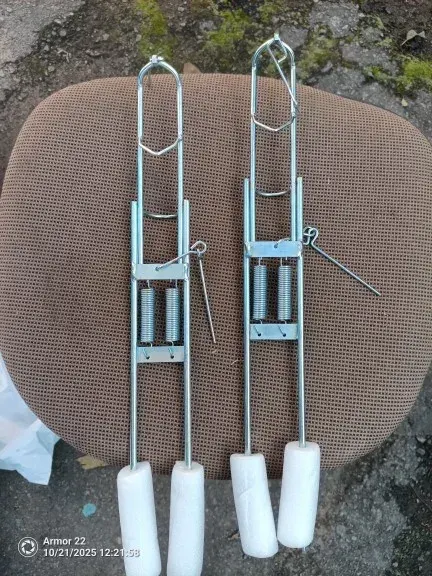
One rod asks the water a single question and waits. Three rods ask three questions at once, and the fish tell you which was right inside an hour.
What follows is the running of a spread, not the choosing of a holder. If you are still picking one, our guide to the best rod holder for bank fishing compares the types and the ground each suits, so none of that is repeated here.
Why a second rod beats working one harder
On a slow morning with one rod you cast to the middle distance, wait, wind in, and push the bait further. By lunchtime you have tested three ranges badly, one after another, and still cannot say whether the fish were close in the whole time.
Put three baits out at once and three answers arrive in parallel. When one rod goes twice in twenty minutes, you know where to put the others. That is why the pack sizes on the automatic spring rod holder run one, two and three: the second and third holder are not spares, they are what turns a guess into a pattern.
Field tip: Once two rods produce at the same range, move the third there too. A spread finds the fish; it is not meant to stay spread once you have.
Where each holder goes along the bank
A straight line of holders looks tidy and fishes badly. Stand behind a straight row and you reach across a loaded line every time the far rod goes. Curve the row into a gentle arc, ends slightly forward of the middle, and every cradle faces your seat.
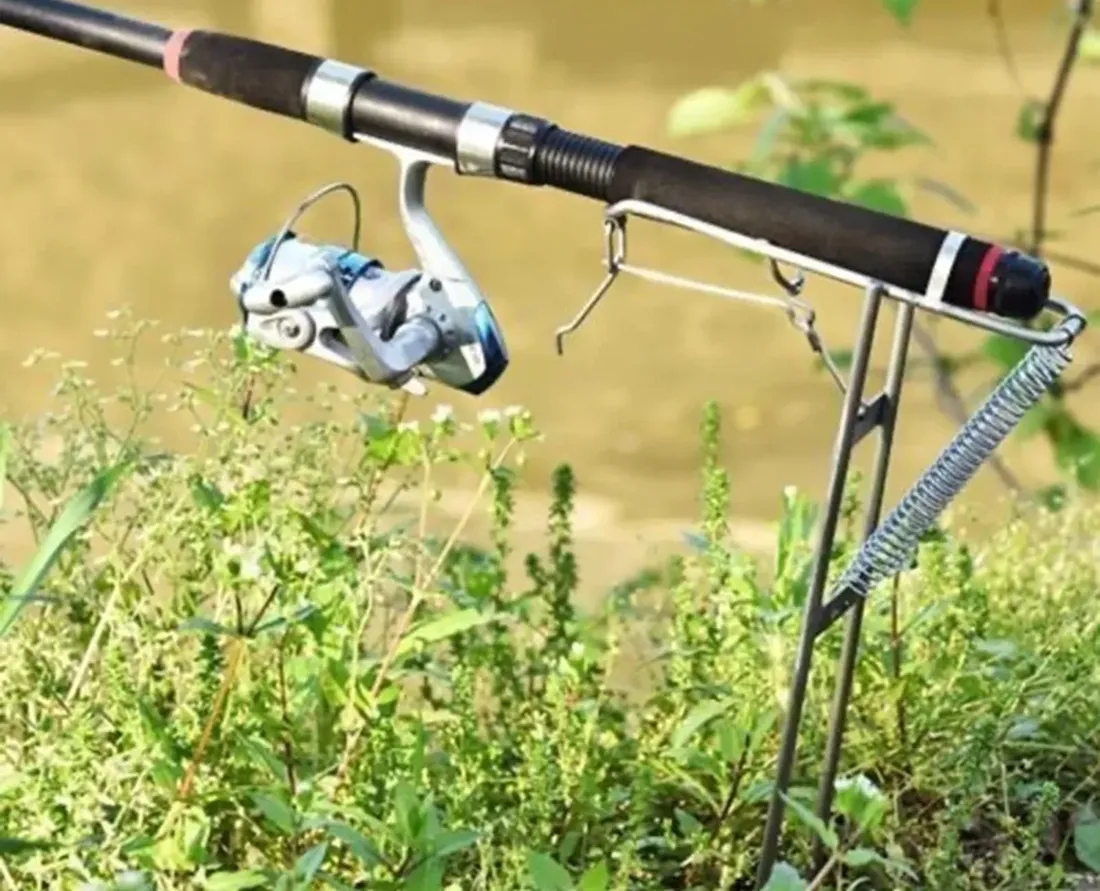
Spacing is set by your arms, not a tape measure: you want to lift one rod out of its cradle without your elbow or the butt touching its neighbour. Plant each one straight down with a firm twist until the top will not wiggle, leaning slightly back from the water. Our automatic spring holder stands about 14 inches (35 cm) in chrome-plated steel, so the whole spread goes in with three pushes and no tools.
Fanning the casts so lines stay apart
The mistake almost everyone makes on their second rod is casting it to the same spot as the first, a few yards over. Two lines heading the same way at the same distance find each other the moment a fish moves or a breeze pushes a bow into one. Think of three baits as points on a wide triangle, not dots on a line.
Range does most of the work: a genuinely short near rod and a genuinely long far rod are separated by open water for their whole length. Cast the far rod first, then the middle, then the near one. If a crossover happens, bring the near rod in and recast it, because dragging the far one back across two lines turns one problem into three.
Near, mid and far: giving every rod a job
Left to itself, a spread collapses. Every recast creeps toward wherever the last fish came from, and by the afternoon three rods are fishing one spot and the search is gone.
| Rod | Where it sits | What it is there to tell you |
|---|---|---|
| Near rod | Just off the margin, close in | Whether fish are patrolling the edge you stand on |
| Mid rod | The comfortable percentage cast | Whether the fish are sitting where they usually sit |
| Far rod | As far out as you can still hold bottom | Whether the fish never come close at all |
The near rod is the one anglers skip and the one that most often surprises them: your own footsteps push fish off the margin early, and they drift back once you settle. For the drag and tip angle each rod wants before you set it down, see how to hold a fishing rod.
Knowing which rod just fired
A tap on the middle rod while you unhook a fish from the near one is a take you never know about. This is the job the automatic holder does that a plain rest does not: when a fish pulls hard enough, the trigger releases, the loaded arm swings up, and the hook is set whether you were looking or not.
Dylan R., a verified buyer, wrote: "The mechanism works perfectly. It hits hard and hooks the fish on its own." Corey B. runs three of them: "Everything is ok, I'll take 3 pieces."
Set the tension per rod, not once for the whole spread: your far rod carries more line and weight, so it wants a firmer setting than a near rod fishing light. In moving water the same logic bites harder, and surf fishing rod holders covers what a constant pull does to a trigger setting.
Setting up and packing down in order
Plant all your holders first, then rig and cast all your rods. It feels slower and it is faster, because you do one type of job at a time and your hands stay dry for the rigging. Plant the far holder first, work back toward the near one, then cast in the same sequence.
Packing down runs the other way. Wind in the near rod, lift it, and pull its holder before you touch the next one. Keeping rod and holder as a pair is the trick: a spike left standing at dusk is nearly invisible, and you find out at the next session when you are one short.
Carrying a spread there and back
Three assembled rods loose across a back seat slide into each other on every corner, and the tips take it. Our fishing rod holder for car is a polyester strap that loops over the headrest posts or ceiling grab handles and carries 5 or 7 rods parallel above the seats, adjusting from 33.5 to 66.9 in (85 to 170 cm) at about 6.7 oz (190 g).
The holders are the easy part: one solid piece of steel each, they go in a rod bag with the tackle. At home they go back on the fishing rod rack alongside the rods, so the spread leaves the house together.
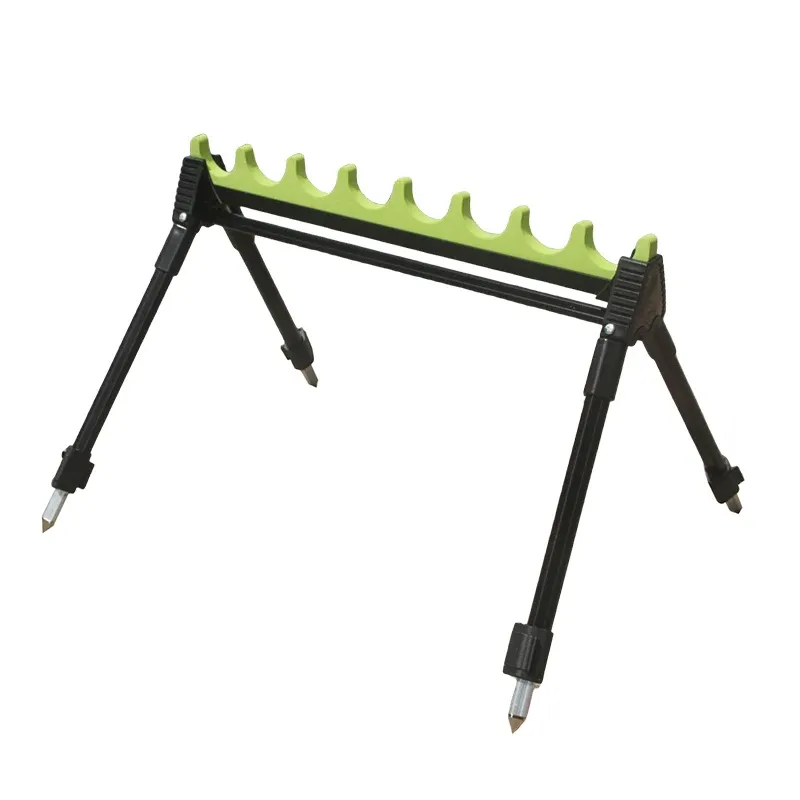
Past three rods a stand does the carrying. The portable fishing rod holder takes eight rods in U-shaped slots on one top bar and folds flat for the trunk, so a big spread travels as one item. Plenty of anglers run both: the stand holds the rods that are resting, the automatic holders work the rods that are fishing.
The spread in short. Three rods at three ranges locate the fish faster than one rod moved three times, and the range that produces is often not the one you would have picked first. Tangles trace back to two baits at similar distances in the same direction, so give every rod its own range and its own slice of water.
Multi-rod fishing by the numbers
Americans went fishing in 2022, most of them from the bank and shore where a spread is set on the ground
— RBFF & Outdoor Foundation, Special Report on Fishing, 2023
saltwater recreational fishing trips U.S. anglers take in a year, gear carried to the water and back each time
— NOAA Fisheries, Marine Recreational Information Program, 2023
total economic output generated by recreational fishing in the U.S. each year
— American Sportfishing Association, Sportfishing in America, 2022
Our picks for running a spread
The automatic spring rod holder comes as a single at $16.95, a two-pack at $24.95, or a three-pack at $34.95. For a bigger spread, the portable folding stand takes eight. All ship free in the US in 6 to 10 business days, with a 30-day money-back guarantee.
Multi-rod fishing questions
How far apart should rod holders be on the bank?
Far enough that you can lift one rod without touching the next, which for most anglers is about a rod length. Set them in a shallow arc rather than a straight line so every butt points back at where you sit.
How do you keep two fishing lines from tangling?
Fan the casts and stagger the distances, so no two lines run side by side. Cast the far rod first, then work inward. If a line crosses, wind the near rod in and recast it rather than dragging the far one back.
Can you use an automatic rod holder for more than one rod?
Each automatic holder takes one rod, so a spread means one holder per rod. That is why the automatic spring holder ships as a single, a two-pack, or a three-pack: you pick the number of rods you want fishing at once.
How many rods can you legally fish at once?
Line limits are set by each state, so the number depends on where you fish and sometimes on the water itself. Your state wildlife agency regulations tell you how many rods you can have out.