· Marcus Hale
Best Rod Holder for Bank Fishing (2026 Field Guide)
Bank fishing is where most anglers start and where a lot of us stay. There is no boat to launch, no ramp fees, and no fuss, just a spot on the shore and a line in the water. The trade-off is that you are standing on uneven, often muddy ground with nowhere natural to rest a rod, which is exactly the problem a rod holder solves for a few dollars.
This guide compares the holder types that actually work on a river or lake bank, based on our own time on the water. We look at what bank fishing demands from a holder, walk through the three main types, and finish with how to set a holder on soft, rocky, or sandy ground so it does not tip when a fish finally takes.
What bank fishing demands from a holder
Shore fishing puts different stresses on a holder than boat or dock fishing. The ground is rarely flat, it changes from soft mud to packed gravel within a few feet, and there is nothing to clamp onto. A holder that works on a manicured lawn can fail on a real riverbank. The best bank holders solve for the ground first, because a holder that will not stay planted is worse than no holder at all. If you also want a refresher on rod handling itself, our guide on how to hold a fishing rod pairs well with this one.
Type 1: Ground-spike holders (our top pick)
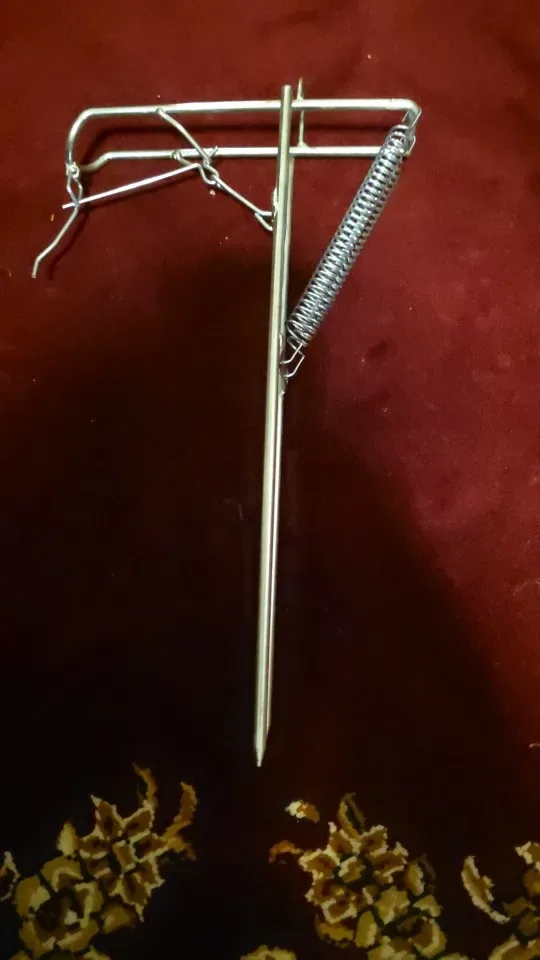
This is the type we reach for first, and our automatic spring fishing rod holder is built around it. It plants into soft ground like a standard spike, but a loaded spring means that when a fish takes the bait, the holder releases and sets the hook on its own. For bait and bottom fishing, where you often step away to re-bait a second rod or check your tackle, that automatic set is the difference between landing a fish and finding an empty hook. It is made from chromed, rust-resistant steel and stands about 14 inches (35 cm), so it packs down small enough to carry with the rest of your gear. It suits the angler who fishes one or two rods on soft or damp banks and wants the holder to do real work.
Field tip: Set the spring tension to match your bait weight. Too light and a current will trip it, too heavy and a shy fish will not. A few test sessions dial it in fast.
Type 2: Portable folding racks
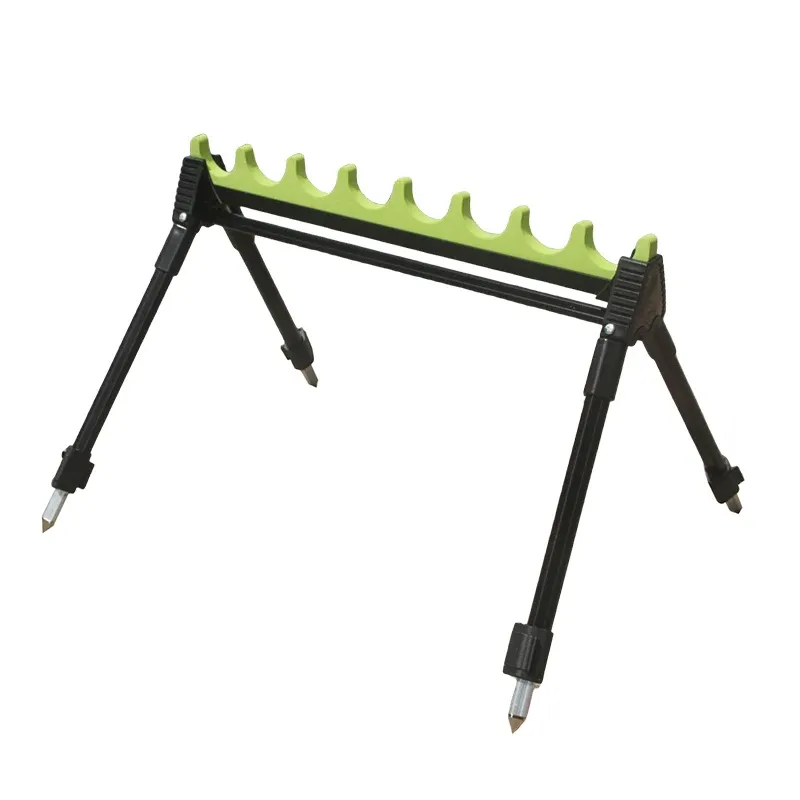
When you fish more than a couple of rods, or when the ground is too hard for a spike, a portable fishing rod holder is the smarter tool. Ours folds flat for carrying, then opens into a stand with a top bar of eight U-shaped notches, so it cradles a full spread of rods at a clean, readable angle. The legs are telescopic with a flip-buckle for height adjustment, and they end in ground spikes that bite into the bank for stability. That combination lets you level the rack on a slope and keep every rod tip visible. It is the pick for the serious bank angler who runs multiple lines or moves between spots with hard footing.
Type 3: Bank sticks and rod pods
If you fish long sessions for carp with bite alarms, a pod earns its place. For the everyday bank angler chasing panfish, catfish, or bass from the shore, a pod is usually more frame than the day calls for. This is where a simple spike or a folding rack gives you most of the benefit for a fraction of the weight and cost. Storing all these rods between trips is a separate job, and a wall or ceiling fishing rod rack keeps them organized at home.
Bank fishing holder comparison
| Type | Best ground | Rods held | Standout feature |
|---|---|---|---|
| Automatic spring spike | Soft to medium soil | 1 per unit | Sets the hook on its own |
| Portable folding rack | Any, incl. hard ground | Up to 8 | Self-standing, height-adjustable |
| Bank stick / rod pod | Soft to medium soil | 1 to 4 | Precise, very stable, heavier |
| DIY PVC spike | Soft soil only | 1 per unit | Cheapest, no hook-set |
On a budget or feeling handy? Our DIY rod holder guide shows how to build a PVC spike, and where it falls short of a manufactured one.
Setting a holder on different ground
On soft mud or clay, a spike goes in easily and holds well, so lean it slightly back away from the water and press it in by at least a third of its length. On packed gravel or rocky banks a spike simply will not seat, and that is when a folding rack with spiked feet wins because it stands on its own weight and footprint. Loose sand is the trickiest, because it flows around a spike and lets it work loose. Bury the base deeper, angle it back, and pile damp sand around it, or again reach for the self-standing rack.
Wind, current, and stability
The most common bank failure we see is a holder pulled flat by a fish while the angler is looking away. It almost always traces back to a base that was set too shallow or too upright. Get the base right and everything else follows. This is also why the automatic spring holder is set up to drive itself deeper under load, and why the folding rack ends in spikes rather than flat feet.
What we found in the field. We tested four holder types across a dozen bank sessions on three water types: a soft river bank, a rocky reservoir shore, and a sandy lake beach. The automatic spring spike was the clear winner on soft and medium ground, landing takes we would have missed while re-baiting. On the rocky reservoir it could not seat at all, and the portable folding rack took over as the most stable option there. Loose sand beat every spike we tried, so the self-standing rack won that ground too. The lesson: pick your holder by your ground first, and by rod count second.
Bank fishing by the numbers
Americans went fishing in 2022, and shore fishing is a top entry point to the sport
— RBFF & Outdoor Foundation, Special Report on Fishing, 2023
total economic output generated by recreational fishing in the U.S. each year
— American Sportfishing Association, Sportfishing in America, 2022
American jobs supported by the recreational fishing industry
— American Sportfishing Association, Sportfishing in America, 2022
Our picks for the bank
For soft and medium ground, the automatic spring rod holder is our top pick because it sets the hook for you. For hard ground or multiple rods, go with the portable folding rod holder. Getting there? The car rod holder keeps your rods safe on the drive. See how each scored on how we test, read real buyer reviews, or learn more about RodPerch.